
 Anthony Lembo
Chronic constipation is a common and often burdensome condition encountered in both primary care and gastroenterology practice. Managing it effectively requires an understanding of constipation subtypes, exclusion of secondary causes, and choosing treatments that fit the patient’s symptoms, comorbidities, and preferences. This review offers a practical, evidence-based guide to managing chronic constipation, including over-the-counter agents and prescription medications. Mechanisms of action, efficacy data, safety considerations, and clinical pearls are highlighted to guide real-world decision-making and improve patient outcomes.
Introduction
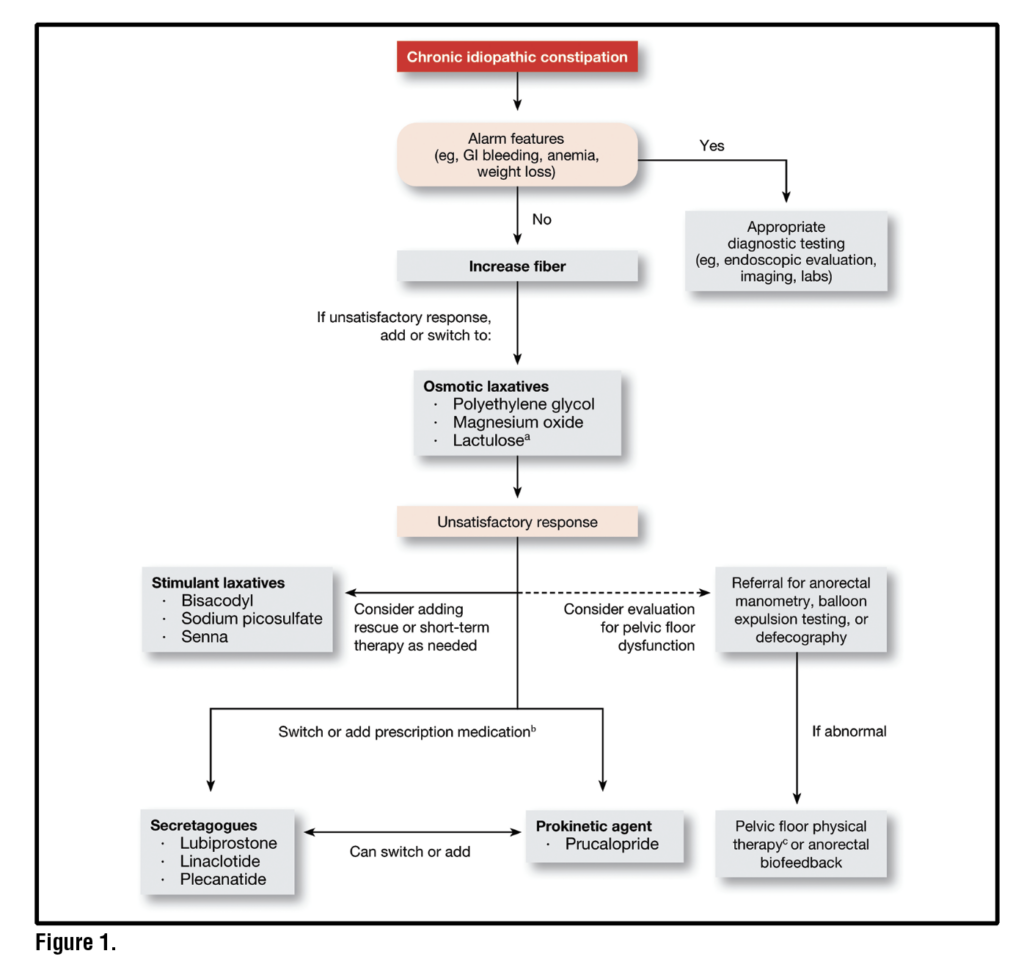
Chronic constipation (CC), also referred to as chronic idiopathic constipation (CIC) or functional constipation (FC), affects approximately 8–12% of adults and is associated with impaired quality of life, increased healthcare utilization, and substantial economic burden.1 CC is characterized by infrequent bowel movements, straining, sensation of anal blockage and/or a sensation of incomplete evacuation in the absence of structural or mucosal disease. CC is subtyped into normal transit constipation or slow transit constipation, with some overlap present. Lifestyle and behavioral measures including adequate hydration, regular physical activity, and dietary changes such as increased fiber intakeoften represent the initial step in treatment. However, a significant proportion of patients fail to achieve adequate relief and require pharmacologic therapy including osmotic and stimulant laxatives, secretagogues, and prokinetic agents.Thisreview follows the pragmatic, stepwise approach recommended by the AGA-ACG Clinical Practice Guideline on the pharmacological management of CC as outlined in Figure 1.2
Diagnosing Chronic Constipation
Chronic constipation is most often defined based on the Rome V Criteria (Table 1).3 While bowel symptoms may overlap with irritable bowel syndrome with constipation (IBS-C), the key differentiator is that abdominal pain and discomfort predominate in IBS-C. Notably many patients may transition between CC and IBS-C over time due to the spectrum and shared pathophysiology of these disorders of gut-brain interactions (DGBI).4
It is essential to exclude secondary causes of constipation. Clinicians should evaluate for alarm features including weight loss, rectal bleeding, anemia, new onset progressing worsening symptoms, family history of colon cancer or inflammatory bowel disease. These signs may warrant further investigation such as colonoscopy. A thorough medication history should be obtained, with specific attention to medications known to cause or worsen constipation, such as opioids, calcium channel blockers, anticholinergics and certain antidepressants. Laboratory tests may be appropriate in select patients to screen for metabolic disorders, such as hypothyroidism, diabetes mellitus and hypercalcemia. A digital rectal examination is an essential part of the evaluation and can help identify a defecatory disorder, such as pelvic floor dyssynergia.5,6 This is best performed by asking the patient to bear down as if attempting to defecate while palpating the anal sphincter and puborectalis muscle during digital examination. Paradoxical contraction or failure to relax these muscles and/or lack of relaxation of the pelvic floor suggests a defecatory disorder. In patients with a suspected defecatory disorder further testing can be considered with anorectal manometry with balloon expulsion or defecography may be appropriate. Evaluation for a defecatory disorder is particularly important since these patients are best managed with anorectal biofeedback therapy.7 All patients should undergo age-appropriate colorectal screening in accordance with established guidelines.
General Principles of Pharmacologic Therapy
Pharmacologic treatment of CC is best approached in a stepwise individualized manner.2 Therapy typically begins with widely available agents and progressing to prescription therapies for patients who do not respond adequately. Factors which may influence treatment selection include stool frequency and consistency, abdominal symptoms (e.g., bloating), patient age, comorbidities, and prior treatment experience. In more complex or refractory cases, combination therapy is often appropriate.
Table 1. Rome V Criteria for Chronic Constipation
| Functional constipation is defined by the presence of ≥2 of the following symptoms for the last 3 months, with symptom onset at least 6 months before diagnosis: Straining during more than 25% of defecations Lumpy or hard stools (Bristol Stool Form Scale types 1–2) in more than 25% of defecations Sensation of incomplete evacuation in more than 25% of defecations Sensation of anorectal obstruction or blockage in more than 25% of defecations Manual maneuvers to facilitate defecation (e.g., digital evacuation, pelvic floor support) in more than 25% of defecations Fewer than three spontaneous bowel movements per week Additional requirements: Loose stools are rarely present without the use of laxatives Criteria for IBS are not met (i.e., abdominal pain is absent or does not meet IBS frequency/severity thresholds) |
Bulk Forming Agents
Bulk forming laxatives are often considered first-line therapy for CC. These include commercially available fibers such as psyllium, methylcellulose, and calcium polycarbophil, which increase stool bulk and water content. Among these, psyllium is the best studied and has the strongest evidence particularly at doses exceeding 10 g/day.8 Notably, psyllium is soluble, gel-forming fiber that retains water, which can improve stool consistency in patients with constipation as well as in patients with loose stools. Gas and bloating are common. Therefore, gradual dose titration is recommended to minimize these side effects. Bulk agents are most effective in patients with mild constipation and normal colonic transit and may not provide relief in patients with slow colonic transit or defecatory dysfunction.9
Osmotic Laxatives
Osmotic laxatives are commonly used firstline pharmacologic agents.
Polyethylene Glycol (PEG)
PEG is a nonabsorbable hydrophilicpolymer that retains water in the lumen thereby softening stool and promoting transit. PEG is FDA approved for occasional constipation though it is now available over the counter and widely used for chronic constipation. Multiple randomized trials have shown consistent efficacy of PEG in improving bowel movement frequency, stool consistency, and global relief of constipation,10,11 though it does not appear to significantly improve abdominal pain in patients with IBS-C.12
PEG has been shown to have superior efficacy compared to lactulose with less bloating,13 and similar outcomes to prucalopride with fewer reports of headaches and nausea.14 PEG is generally well-tolerated though bloating, flatulence and diarrhea is sometimes reported. Due to its safety profile, wide availability and affordability, PEG is a preferred agent among osmotic laxatives.
Lactulose
Lactulose is a non-absorbable synthetic disaccharide that functions as an osmotic laxative. Although older studies showed modest improvements in bowel frequency and global symptom relief, the quality of evidence is low due to small sample sizes, risk of bias and lack of modern diagnostic criteria and endpoints. Adverse events such as bloating and flatulence are common and often limit dose escalation. Lactulose is FDA approved for CIC and may be a reasonable option in patients who have failed fiber and other OTC laxatives. Lactulose is considered to be safe for use in pregnancy.2
Magnesium Containing Agents
Magnesium hydroxide and magnesium citrate are effective osmotic laxatives and are commonly used as OTC therapies. Because magnesium can be absorbed from the gastrointestinal tract, high doses (i.e.,>1.5-2 grams per day) should be avoided to avoid hypermagnesemia. In a trial conducted in Japan, magnesium hydroxide (1.5 grams per day) improved symptoms in patients with chronic constipation.15 Likewise, in older individuals or patients with renal insufficiency, chronic use of magnesium agents should be used cautiously and monitored.
Stimulant Laxatives
Stimulant laxatives, including senna and bisacodyl, work by stimulating colonic motility and increasing water secretion in the bowel lumen.16 They are typically used as short-term rescue or adjunctive agents when osmotic agents like polyethylene glycol (PEG) and fiber are not effective. Stimulant laxatives are widely available and are relatively inexpensive. They appear to be efficacious in improving constipation, though only a limited number of studies have been conducted.15,17 No high-quality long-term efficacy or safety data exist. While abdominal cramping and diarrhea are frequent, long-term mucosal damage or dependence does not appear to occur.18
Intestinal Secretagogues
These agents promote intestinal fluid secretion and accelerate transit. They are typically used in patients with moderate to severe symptoms or inadequate response to over-the-counter therapies.
Lubiprostone
Lubiprostone is a chloride channel (ClC-2) activator that increases intestinal fluid secretion and improves stool form and consistency. It is FDA approved for CIC in adult men and women at a dose of 24 mcg twice daily, and for IBS with constipation (IBS-C) in adult women only at a dose of 8 mcg twice daily. Nausea is the most common adverse effect occurring in approximately 30% of patients.19 However, it is generally transient and may be mitigated by taking lubiprostone with food.
Linaclotide
Linaclotide is a guanylate cyclaseC agonist that increases chloride and bicarbonate secretion into the lumen by opening cystic fibrosis transmembrane conductance regulator (CFTR) through an intracellular secondary messenger (cyclic GMP). Linaclotide also appears to reduce visceral pain signaling. It is approved for CIC at a dose of 72 mcg and 145 mcg once daily and IBS-C at a dose of 290 mcg once daily. Linaclotide should be taken on an empty stomach 30 minutes before breakfast.
In large phase 3 clinical trials linaclotide has shown efficacy across multiple endpoints, including stool frequency, consistency, bloating and abdominal pain. Diarrhea is the most common adverse event and resulted in 4.7% of patients withdrawing from the phase 3 clinical trials.20
Plecanatide
Plecanatide is another guanylate cyclaseC agonist similar to linaclotide. However, unlike linaclotide, plecanatide is pH sensitive. It is FDA approved for both CIC and IBS-C at a dose of 3 mg once daily, taken with or without food. The efficacy of plecanatide is similar to linaclotide, improving stool frequency, consistency, and patient-reported global constipation relief. Diarrhea is also the most common adverse event and resulted in 2.7% of patients withdrawing from the phase 3 clinical trials.21
Prokinetic Agents
Prucalopride
Prucalopride is a selective 5HT4 receptor agonist that stimulates colonic motility and accelerates intestinal transit. It is approved for CIC at a dose of 2 mg (1 mg for those with severe renal insufficiency). It may be taken with or without food. Prucalopride is not approved for IBS-C. Because of prokinetic properties, prucalopride may be particularly effective in patients with slow transit constipation. Headache, nausea, and diarrhea are the most common side effects, typically occurring early in therapy. In phase 3 trials, withdrawals from these side effects were low (<3%).22 In a network meta-analysis, among studies with trials of at least 12 weeks in duration, prucalopride appeared to be the most efficacious of the medications for chronic constipation.10
Combination Therapy
Combining agents with complementary mechanisms (e.g., PEG plus a stimulant laxative or secretagogue) is often effective in refractory constipation and reflects real-world clinical practice.
Complementary and Novel Therapies
Nontraditional interventions such as electroacupuncture and mechanical devices have been investigated for CC. A large multicenter trial conducted in China involving over 1,000 patients with severe CC found 8 weeks of electroacupuncture (28 sessions) significantly increased in mean weekly number of spontaneous and complete spontaneous bowel movements (CSBMs) compared to baseline (1.76 vs. 0.87 CSBMs per week) than sham acupuncture. Electroacupuncture also improved stool form and quality of life.23 More recently, an orally vibrating colon stimulating capsule was cleared by the FDA for CC. In a Phase III trial, patients receiving the vibrating capsule achieved significantly higher rates of CSBM response compared with placebo (e.g., ~39.3% vs 22.1% for >1 CSBM increase per week, and ~22.7% vs 11.4% for >2 CSBM per week), along with improvements in straining, stool consistency, and quality of life. Adverse events were generally mild and gastrointestinal in nature, with reports of a vibrating sensation in about 11% of treated patients.24
Practical Treatment Algorithm for Chronic Constipation
- Exclude secondary causes including medications potentially
- Initiate gradual titration of fiber supplementation (e.g. psyllium) > 10 g per day
- Add PEG 17-34 grams per day
- Add or substitute stimulant laxatives as needed
- Escalate to secretagogues (lubiprostone, linaclotide, or plecanatide) or prokinetic agents (prucalopride) for persistent symptoms
- Consider combination therapy and reassess diagnosis in refractory cases
Conclusion
Pharmacologic management of CC requires an individualized, stepwise approach that balances efficacy, tolerability, and patientcentered outcomes. A growing array of therapeutic options allows clinicians to tailor treatment based on symptom profile and underlying pathophysiology. Familiarity with mechanisms of action and practical use of these agents can substantially improve symptom control and quality of life for patients with chronic constipation.
References
1. Sperber AD, Bangdiwala SI, Drossman DA, et al. Worldwide Prevalence and Burden of Functional Gastrointestinal Disorders, Results of Rome Foundation Global Study. Gastroenterology 2021;160:99-114 e3.
2. Chang L, Chey WD, Imdad A, et al. American Gastroenterological Association-American College of Gastroenterology Clinical Practice Guideline: Pharmacological Management of Chronic Idiopathic Constipation. Gastroenterology 2023;164:1086-1106.
3. Corsetti M, Shin A, Lacy BE, Cash BD, Simrén M, Schmulson MJ, Hou X, Lembo A. Bowel Disorders. Gastroenterology. 2026 May;170(6):1261-1282. doi: 10.1053/j.gastro.2026.02.003. Epub 2026 Feb 17. PMID: 41713703.
4. Heidelbaugh JJ, Stelwagon M, Miller SA, et al. The spectrum of constipation-predominant irritable bowel syndrome and chronic idiopathic constipation: US survey assessing symptoms, care seeking, and disease burden. Am J Gastroenterol 2015;110:580-7.
5. Rao SSC. Digital Rectal Examination: An Invaluable Clinical Tool. Gastro Hep Adv 2024;3:592-593.
6. Brandler J, Camilleri M. Pretest and Post-test Probabilities of Diagnoses of Rectal Evacuation Disorders Based on Symptoms, Rectal Exam, and Basic Tests: a Systematic Review. Clin Gastroenterol Hepatol 2020;18:2479-2490.
7. Rao SS, Benninga MA, Bharucha AE, et al. ANMS-ESNM position paper and consensus guidelines on biofeedback therapy for anorectal disorders. Neurogastroenterol Motil 2015;27:594-609.
8. Rao SSC, Brenner DM. Efficacy and Safety of Over-the-Counter Therapies for Chronic Constipation: An Updated Systematic Review. Am J Gastroenterol 2021;116:1156-1181.
9. Bijkerk CJ, de Wit NJ, Muris JW, et al. Soluble or insoluble fibre in irritable bowel syndrome in primary care? Randomised placebo controlled trial. BMJ 2009;339:b3154.
10. Luthra P, Camilleri M, Burr NE, et al. Efficacy of drugs in chronic idiopathic constipation: a systematic review and network meta-analysis. Lancet Gastroenterol Hepatol 2019;4:831-844.
11. Menees SB, Lembo AJ, Chey WD. Polyethylene Glycol 3350 in the Treatment of Chronic Idiopathic Constipation: Post hoc Analysis Using FDA Endpoints. Can J Gastroenterol Hepatol 2022;2022:3533504.
12. Chapman RW, Stanghellini V, Geraint M, Halphen M. Randomized clinical trial: macrogol/PEG 3350 plus electrolytes for treatment of patients with constipation associated with irritable bowel syndrome. Am J Gastroenterol 2013;108:1508-15.
13. Lee-Robichaud H, Thomas K, Morgan J, Nelson RL. Lactulose versus Polyethylene Glycol for Chronic Constipation. Cochrane Database Syst Rev 2010:CD007570.
14. Cinca R, Chera D, Gruss HJ, Halphen M. Randomised clinical trial: macrogol/PEG 3350+electrolytes versus prucalopride in the treatment of chronic constipation – a comparison in a controlled environment. Aliment Pharmacol Ther 2013;37:876-86.
15. Morishita D, Tomita T, Mori S, et al. Senna Versus Magnesium Oxide for the Treatment of Chronic Constipation: A Randomized, Placebo-Controlled Trial. Am J Gastroenterol 2021;116:152-161.
16. Corsetti M, Landes S, Lange R. Bisacodyl: A review of pharmacology and clinical evidence to guide use in clinical practice in patients with constipation. Neurogastroenterol Motil 2021;33:e14123.
17. Kamm MA, Mueller-Lissner S, Wald A, et al. Oral bisacodyl is effective and well-tolerated in patients with chronic constipation. Clin Gastroenterol Hepatol 2011;9:577-83.
18. Whorwell P, Lange R, Scarpignato C. Review article: do stimulant laxatives damage the gut? A critical analysis of current knowledge. Therap Adv Gastroenterol 2024;17:17562848241249664.
19. Johanson JF, Morton D, Geenen J, Ueno R. Multicenter, 4-week, double-blind, randomized, placebo-controlled trial of lubiprostone, a locally-acting type-2 chloride channel activator, in patients with chronic constipation. Am J Gastroenterol 2008;103:170-7.
20. Lembo AJ, Schneier HA, Shiff SJ, et al. Two randomized trials of linaclotide for chronic constipation. N Engl J Med 2011;365:527-36.
21. Miner PB, Jr., Koltun WD, Wiener GJ, et al. A Randomized Phase III Clinical Trial of Plecanatide, a Uroguanylin Analog, in Patients With Chronic Idiopathic Constipation. Am J Gastroenterol 2017;112:613-621.
22. Shin A, Camilleri M, Kolar G, et al. Systematic review with meta-analysis: highly selective 5-HT4 agonists (prucalopride, velusetrag or naronapride) in chronic constipation. Aliment Pharmacol Ther 2014;39:239-53.
23. Chakraborty S, Bharucha AE. In chronic severe functional constipation, electroacupuncture increased complete spontaneous bowel movements. Ann Intern Med 2016;165:JC69.
24. Rao SSC, Quigley EMM, Chey WD, et al. Randomized Placebo-Controlled Phase 3 Trial of Vibrating Capsule for Chronic Constipation. Gastroenterology 2023;164:1202-1210 e6.